
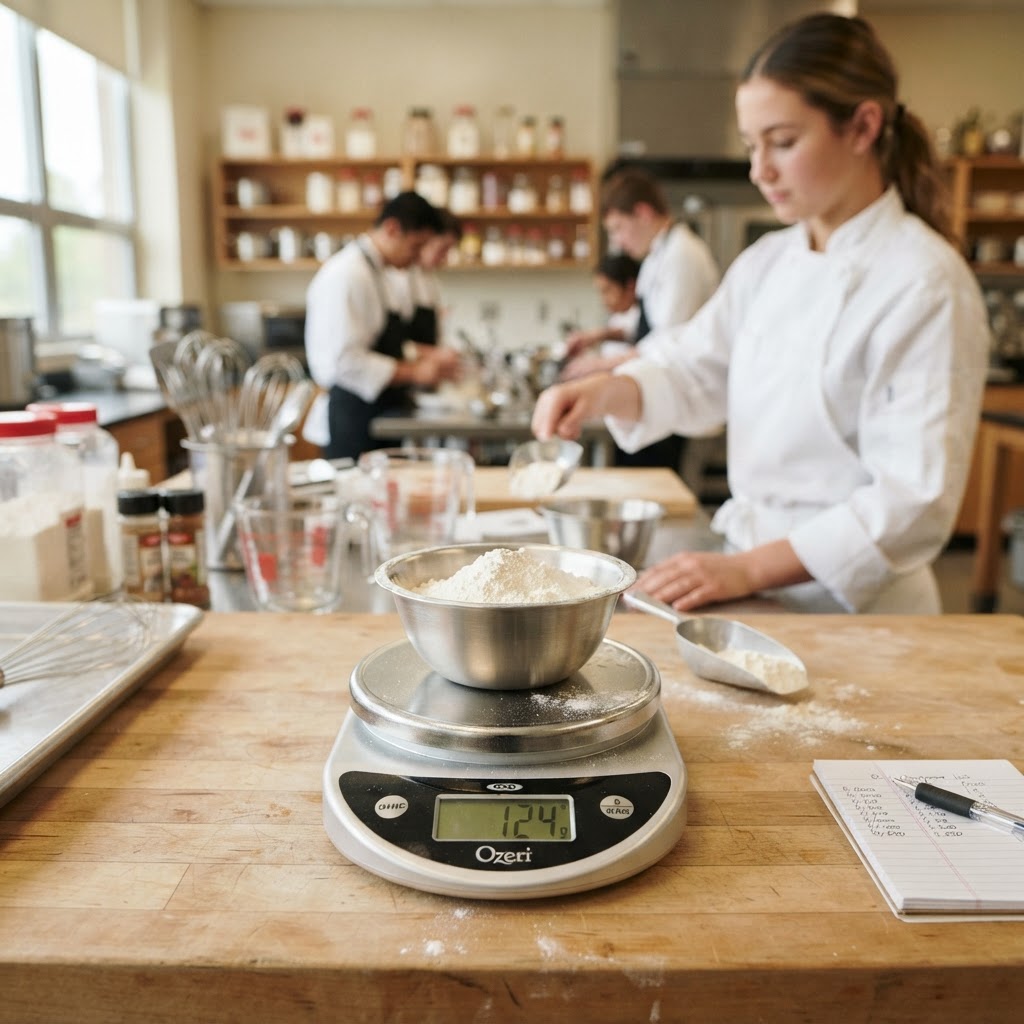
Why Precision Matters: Teaching Volumetric Error and Measurement Science in the Culinary Lab
Teach your students why using digital scales instead of measuring cups is essential for achieving consistent, professional results in every baking project.
Professional bakers choose to measure ingredients by mass rather than volume for a very specific reason. When students use traditional measuring cups to scoop flour, they often inadvertently pack the powder into the cup. This compression significantly increases the density of the ingredient. A single cup of packed flour can weigh far more than a cup of loosely sifted flour. In the world of baking, where precise ratios of protein, starch, and water dictate the final structure of a cake or loaf of bread, these small, hidden variations shift the final outcome from a light, tender crumb to a dense, tough, and rubbery texture that is difficult to chew.
The Physics of Volumetric Error
Volume represents the amount of space an ingredient occupies. Mass represents the actual amount of matter present in that space. Traditional measuring cups rely entirely on volume. However, dry ingredients like flour, sugar, and cocoa powder are full of tiny, microscopic air pockets. The amount of air trapped in these ingredients changes drastically based on how the cup is filled, how the ingredient is stored in the pantry, and even the daily humidity of your classroom. This phenomenon creates inherent volumetric error. When students scoop directly from a bag, they apply downward pressure that collapses these air pockets. The result is an inconsistent amount of ingredients in the mixing bowl. True precision in the culinary lab starts by acknowledging that volume is merely an estimate, while mass is a reliable, repeatable measurement.
Defining Measurement Accuracy and Precision
Accuracy describes how close a measurement is to the actual target value. Precision describes how consistent those measurements are across multiple attempts. If a student measures one cup of flour three different times using a scoop, they will likely get three different weights. This shows low precision. If they use a digital scale to measure exactly 120 grams of flour, they will get 120 grams every single time. High precision leads to reproducible results. In a high school classroom, reproducibility is the foundation of true scientific inquiry. If a student cannot reliably replicate their own work, they cannot determine why a culinary product succeeded or failed. Developing this consistency is the first step toward professional-grade baking skills.
The Impact on Culinary Functionality
Baking is fundamentally a series of precise chemical reactions. Flour provides the necessary gluten-forming proteins and starches for structure. If a recipe calls for 200 grams of flour and a student accidentally adds 250 grams due to inaccurate volumetric measuring, the ratio of water to flour is ruined. The dough becomes too dry and the gluten network becomes overly rigid and tough. Conversely, adding too little flour leads to a weak structure that collapses in the oven, leaving a gummy center. When teaching these concepts, have your students measure one cup of flour using three methods: dipping the cup directly into the bag, spooning it into the cup, and weighing it on a scale. Comparing the mass of these three samples provides immediate, visible, and tangible evidence of why the digital scale is the superior tool for every baker.
Practical Classroom Strategies
Transitioning students from volumetric tools to digital scales takes patience. Start by thoroughly discussing the concept of tare weight. Teach your students that the weight of the bowl or container must be subtracted before adding the ingredient. Show them how to stabilize a scale on a flat, even surface to avoid calibration errors. When the lab session is over, have them record the mass of every ingredient used. This creates a data set they can analyze later. If a product fails to rise, the students can look back at their records to see if a measurement error occurred. This effectively turns your school kitchen into a real laboratory where failure becomes a learning data point rather than just a frustration.
Classroom Takeaways
- Use digital scales as the primary measurement tool to minimize error and increase student success in every recipe.
- Require students to record the exact mass of ingredients in grams to build professional habits of quantitative reporting.
- Conduct a comparative lab where students measure flour using volume versus mass to see the physical differences firsthand.
- Discuss how ingredient density significantly affects the final texture and structure of various baked goods.
- Encourage students to analyze their measurement records when a product does not meet the expected target characteristics.
- Explain that baking is a science, and consistency in measurement is the most important variable students can control.
- Use consistent weighing practices to help students understand how humidity and packing affect ingredient weight over time.
Was this article useful?
Sign in with a free or paid account to react. A paid plan is not required.
Enjoy this post? Subscribe to get new Food Science Toolbox articles delivered to your inbox.