
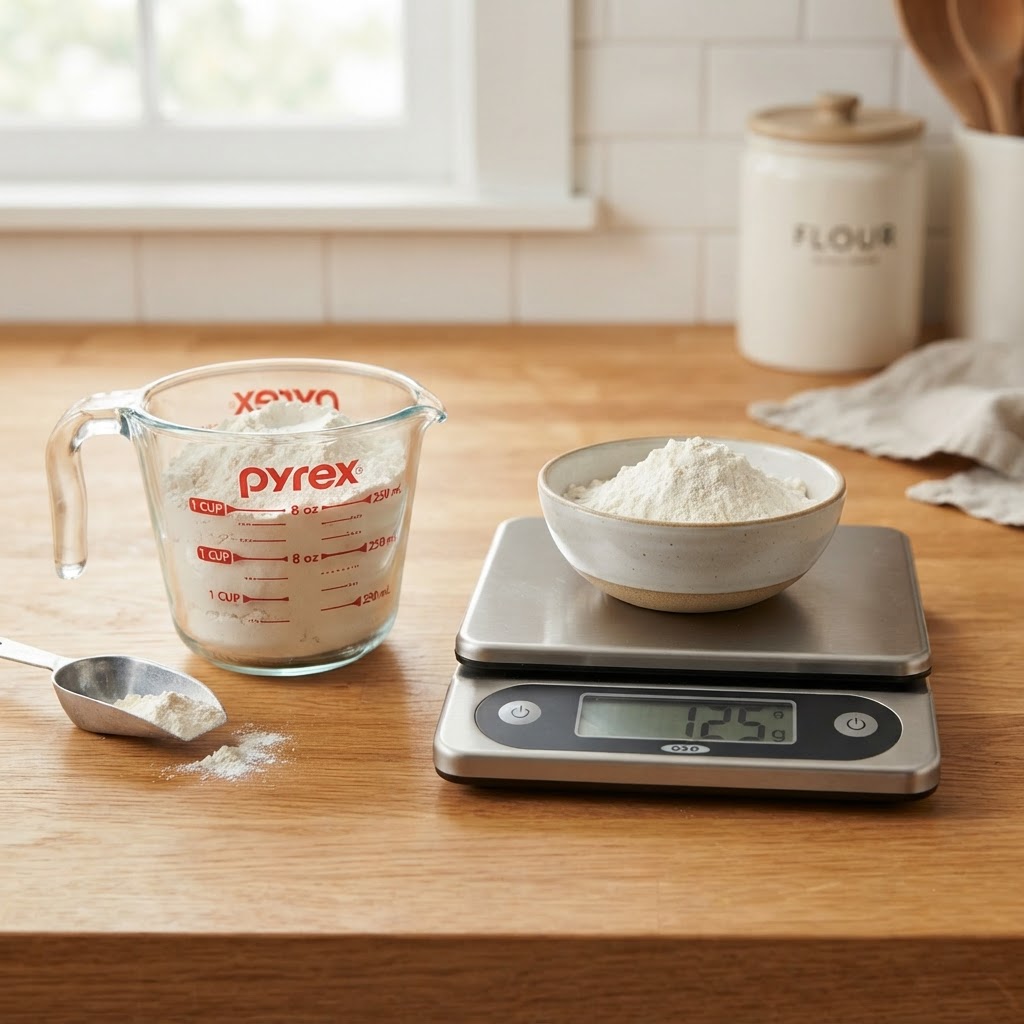
The 'Cup' Misconception: Why Standard Volume Isn't Standard
Measuring by volume introduces hidden variables in your kitchen labs, so switching to mass provides the scientific accuracy your students need for consistent, predictable results.
When students measure a cup of flour for a quick bread lab, they often trust their equipment without question. They might dip a measuring cup into a bag, pack it down, and level it off. In their minds, they have added a specific, consistent amount of dry ingredients. This process, while common in home kitchens, introduces significant variability that impacts the texture and chemical structure of the final product.
Volume measures the amount of space an ingredient occupies, rather than its mass. The challenge arises because ingredients shift, settle, and trap air. A cup of all-purpose flour can weigh anywhere from 120 grams to over 160 grams depending on how forcefully it was packed or how much it settled during transit. When students assume that volume equals a fixed quantity, they introduce hidden variables that make it nearly impossible to troubleshoot failed lab results.
The Physics of Packing and Density
The primary issue with volume measurement is packing fraction. This refers to the percentage of space within a container that is occupied by the substance versus the air between particles. Granular materials like flour, sugar, or cocoa powder are not solid blocks. They contain voids, or pockets of air, that change shape and size based on how the material is handled.
Think about a bag of powdered sugar. When you first open it, the sugar is light and aerated. After a week in the pantry, the weight per cup increases because gravity causes the particles to settle, reducing the air space between them. If students rely on a measuring cup, they are not measuring a specific amount of substance. They are measuring a specific amount of space filled with a mix of matter and air. In contrast, mass remains constant regardless of how much air is trapped inside the ingredient.
Accuracy Versus Precision in the Classroom
In culinary science, accuracy describes how close a measurement is to the true value required by a formula. Precision describes how repeatable a measurement is across multiple trials. Using volume, students might be precise in their physical motion, such as dipping the cup the same way each time, but they remain inaccurate because the density of the ingredient changes every time they scoop.
Using a digital scale introduces a higher level of accuracy. When a recipe calls for 125 grams of flour, the reading remains 125 grams regardless of whether the flour was sifted or packed. This consistency is essential for students to learn because it separates variables related to the ingredient itself from variables related to the technique. If a batch of muffins turns out too dense, they can look at their mixing technique or leavening agents knowing the flour content was correct.
Scientific Implications for Baking
Baking relies on the precise interaction of ingredients like gluten-forming proteins, fats, and starches. These chemical structures are sensitive to the ratios of ingredients. If a student adds 20 percent more flour because they packed the cup, the moisture-to-flour ratio shifts dramatically. This excess of starch and protein can result in dry, tough, or poorly risen products that do not represent the actual science of the recipe.
Understanding this distinction helps students appreciate why professional bakers and food scientists prioritize mass measurements. It turns the kitchen into a laboratory where results become predictable. When students realize that the measuring cup is a source of error, they start to view recipes as formulas. This shift in perspective encourages them to treat the kitchen as a place where measurement, observation, and consistency drive success.
Integrating Mass in Your Lessons
You do not need an entire set of expensive lab balances to demonstrate this. A simple classroom experiment involves having students measure one cup of flour using different techniques, such as the scoop-and-level method, the sift-and-spoon method, and the packed-down method. Have them weigh each sample on a single scale.
The variation they see in the gram readings provides an immediate, tangible explanation for why their baked goods sometimes vary from group to group. It makes the abstract concept of density concrete. This observation leads naturally to a discussion about why consistent measurements are required to control the variables that affect chemical reactions in food. When students see the data, they understand that switching to mass is not just about being fancy, but about being scientifically rigorous.
Key Takeaways
- Volume measurements are inherently inaccurate for dry ingredients because they fail to account for variations in packing density and air content.
- Mass provides a consistent, objective standard that ensures the same chemical ratios are maintained in every attempt at a recipe.
- The discrepancy between volume and mass demonstrates how environmental factors like settling can alter the outcome of a controlled food experiment.
- Teaching students to measure by mass transforms the kitchen into a predictable laboratory environment where they can better analyze the variables of their work.
Was this article useful?
Sign in with a free or paid account to react. A paid plan is not required.
Enjoy this post? Subscribe to get new Food Science Toolbox articles delivered to your inbox.