
Beyond 'Don't Cut Yourself': Creating Effective Kitchen Safety SOPs for the Classroom
Learn how to use science-backed safety protocols and student-led accountability to create a safe, consistent, and professional food lab environment for your middle schoolers.
Standard Operating Procedures, or SOPs, are much more than just a list of rules for a kitchen. In a food science lab, they are the vital scientific protocols that ensure consistent, successful results and human safety. Middle school students thrive when they understand the purpose behind every rule. If you explain that wiping up a spill immediately prevents a fall due to the simple physics of friction, students are far more likely to comply than if you simply bark a command. By teaching the science behind the safety, you turn a chore into a learning moment.
Building Your SOP Framework
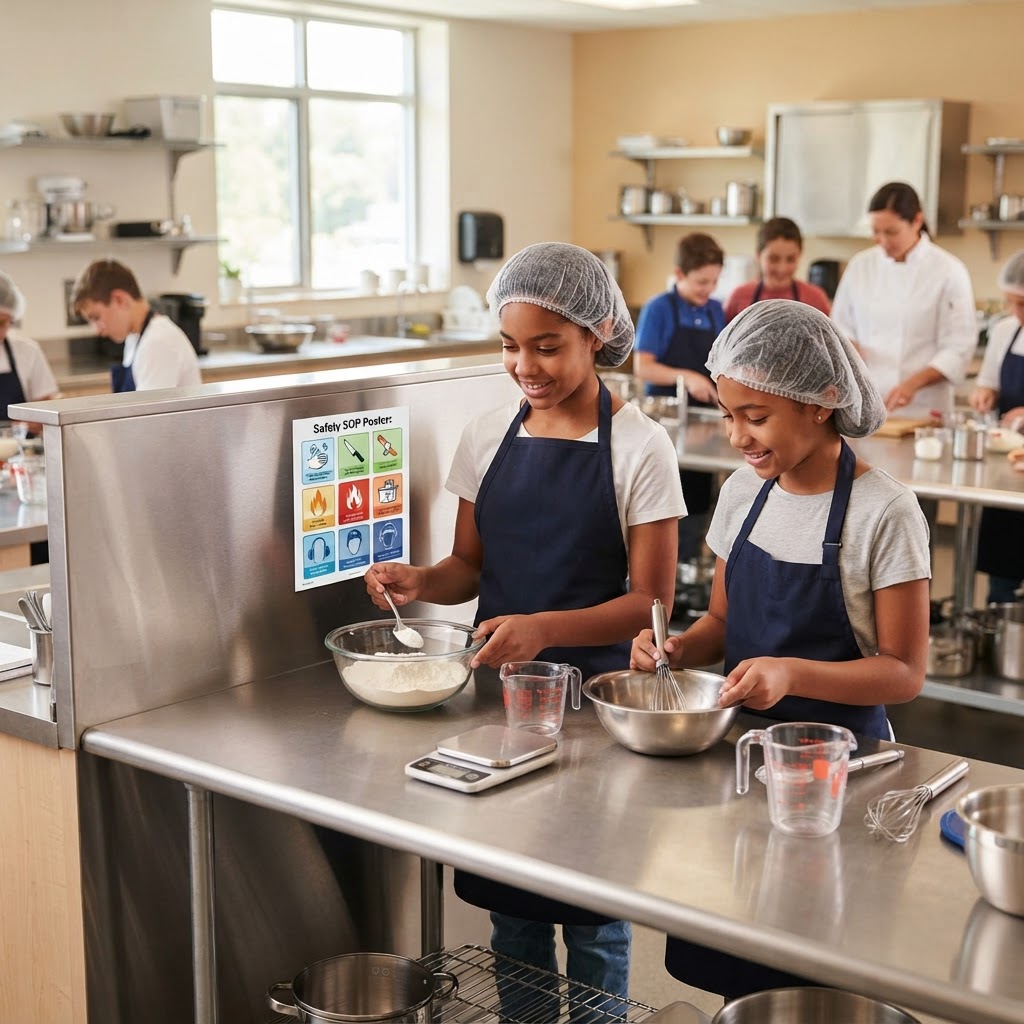
An effective SOP should be short, visual, and action-oriented. Middle school students process written text much better when it is paired with clear, real-life images. Create one-page guides for the most common lab activities, such as sanitizing workstations, using a chef's knife, or operating the dishwasher. Avoid dense, boring paragraphs at all costs. Use bold headers and bullet points to emphasize safety-critical steps that keep everyone in the room protected. Remember that if a student cannot read it in under thirty seconds, it is likely too long for a busy lab environment.
The Role of Food Science in Safety
Safety procedures often overlap with sanitation in amazing ways. For example, the concept of cross-contamination is a fundamental food science principle that affects everyone. Teach students that microbes like bacteria are completely invisible to the naked eye. Because they cannot be seen, SOPs must be absolute and non-negotiable. When students handle raw food like chicken, the procedure requires a physical barrier, such as a color-coded cutting board, and a chemical intervention, such as washing hands with warm water and soap for twenty full seconds. By framing these tasks as scientific requirements rather than busywork, you elevate the student role to that of a professional lab technician.
Implementing Routine and Accountability
Consistency is your greatest tool for classroom management. When a student enters your lab, they should follow the exact same entry SOP every single day. This might involve washing hands immediately, putting on a clean apron, and tying back long hair securely. If the routine is predictable, the mental load on students decreases, which leaves much more room for them to focus on the actual culinary task at hand. When everyone knows the drill, your stress levels will naturally decrease as well.
Accountability works best when it is collaborative and fun. Pair students into lab teams. Give one student the rotating role of Safety Officer for the day. This student uses a simplified, laminated checklist to verify that their group followed the SOPs during the lab. This creates a powerful peer-to-peer culture of safety. You are no longer the only person looking for potential hazards because the students are actively monitoring their own environment for you.
Designing the SOP Documentation
Keep your documentation simple and clean. Use a basic grid layout for your handouts. The first column lists the action, the second column explains the scientific reason for the action, and the third column features a photo of a student performing the action correctly. If you teach knife skills, the action is using the claw grip. The reason is that tucking the fingertips prevents them from ever being in the path of the blade. The image clearly shows the fingers curled inward, which acts as a guide for visual learners.
Classroom Takeaways
Use color-coded zones for different tasks to naturally prevent cross-contamination.
Assign a student Safety Officer role to rotate responsibility among team members every week.
Link every safety rule to a specific scientific reason to improve student buy-in.
Post large, visual step-by-step posters at every workstation for quick, easy reference.
Conduct a short safety demonstration before every single lab, no matter how simple the task seems.
Create an emergency protocol card that students can keep in their pockets during active cooking.
Reward teams that maintain a clean station at the end of the period to reinforce good habits.
Safety is not a one-time lesson. It is a set of habits built through constant repetition and positive reinforcement. When your students master these SOPs, they move from being novices to being responsible lab participants. This discipline protects the students and allows you to teach more complex, engaging food science concepts with confidence and peace of mind.
Was this article useful?
Sign in with a free or paid account to react. A paid plan is not required.
Enjoy this post? Subscribe to get new Food Science Toolbox articles delivered to your inbox.