
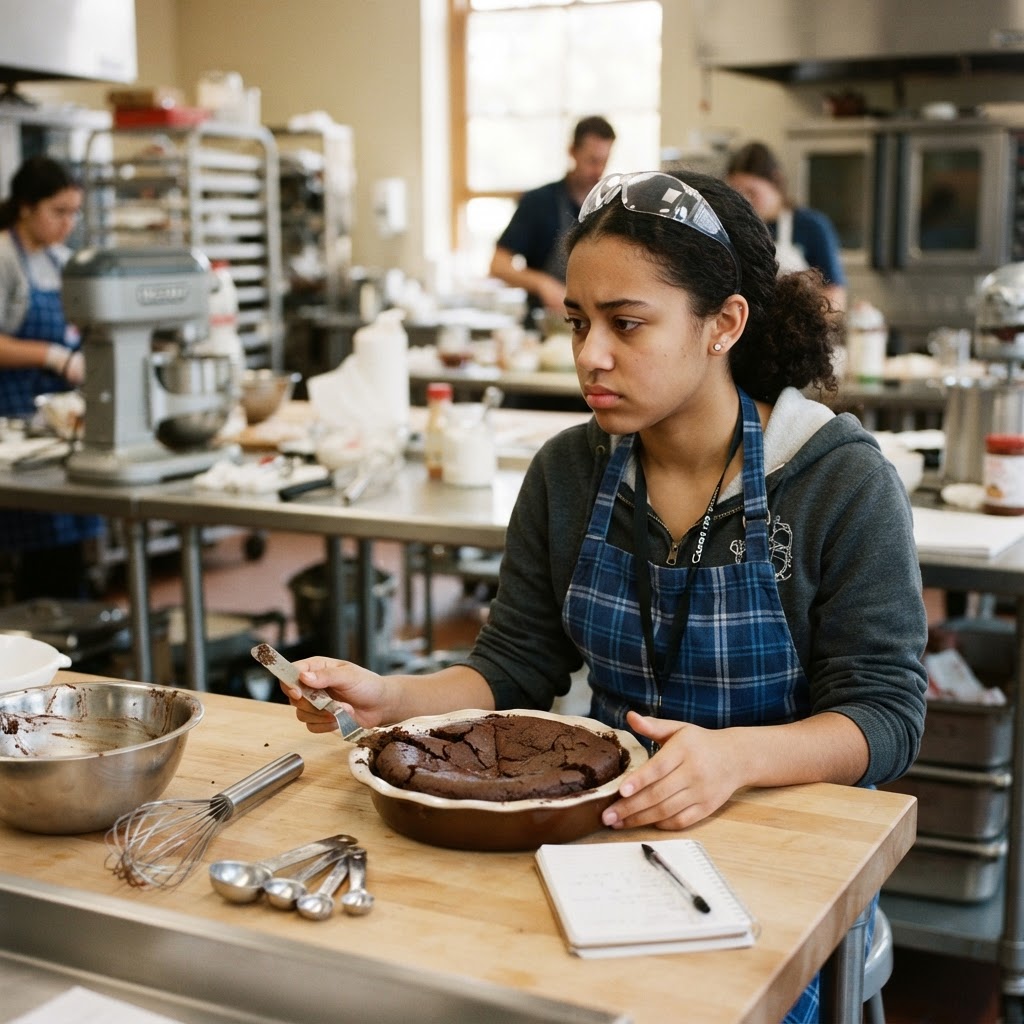
What If Your Students Faced These 10 Common Kitchen Mistakes?
Students often struggle to link cooking mistakes to scientific principles. This scenario-based activity helps your class connect kitchen errors to core food science concepts for better troubleshooting and deeper understanding.
Turning Kitchen Mistakes Into Lessons
When students work in the kitchen, mistakes are inevitable. Whether it is an oven temperature set too high or a forgotten ingredient, these errors often lead to confusion rather than understanding. Instead of viewing these moments as setbacks, you can transform them into powerful learning opportunities. By examining the science behind common mistakes, students move beyond memorizing rules and begin to understand the chemical and biological processes governing food preparation. These moments are where the real learning happens if you have the right tools to guide them.
Why Chemistry Matters in the Kitchen
Consider what happens when a student accidentally swaps baking soda for baking powder. To solve this, a student needs to understand the function of chemical leaveners. Baking soda is a pure base that requires an acid to create carbon dioxide gas. Without an acidic component like buttermilk, the reaction remains incomplete, often leaving behind a bitter taste. Conversely, baking powder contains both a base and a dry acid. If a student uses baking soda without adding acid, the bread will not rise, resulting in a dense, compact crumb. This shows that cooking is essentially a series of controlled chemical reactions. When students mess up their ratios, ask them to map out the chemical reaction that failed to occur.
Safety and Microbial Growth
Safety mistakes provide another avenue for scientific inquiry. If a student leaves a pot of stock on the counter for several hours, the situation is ripe for a lesson on microbial growth. Food science teaches us that the danger zone for rapid microbial proliferation is between 40 and 140 degrees Fahrenheit. Discussing why refrigeration stops this growth, by lowering the kinetic energy of molecules, helps students recognize the critical relationship between temperature and food spoilage. You can use these real-time errors to show how foodborne illness is prevented through simple, effective thermal management.
Precision and Emulsions
Precision and accuracy often become confused in the classroom. A student might use the right tool but fail to be precise if they do not level off ingredients, which changes the hydration ratio of dough. This affects the development of the gluten network. When you introduce the Food Science: What Would Happen If: A Scenario-Based Discussion Activity, you provide a structured way for students to analyze these variables. The resource challenges students to predict outcomes based on specific errors, forcing them to justify their predictions using concepts like coagulation and denaturation. It turns a simple kitchen goof into a rigorous academic exercise in cause and effect.
Understanding emulsion stability is another area where things often go wrong. Emulsions are unstable mixtures of oil and water. If a student adds oil to egg yolks too quickly when making mayonnaise, the emulsion breaks because the mechanical energy is insufficient to overcome surface tension. This activity allows you to present students with a broken emulsion and ask them to explain the physical chemistry behind the collapse. By focusing on the breakdown of the bonds, students gain a better grasp of how emulsifiers work to bridge the gap between oil and water.
The Role of pH and Protein Structure
You can also explore the impact of pH on protein structure. If a student adds too much lemon juice to a cream sauce, the acid denatures the casein proteins by bringing them closer to their isoelectric point. At this point, the proteins aggregate, causing them to curdle. By discussing these scenarios as a class, students develop the ability to diagnose problems and suggest interventions, which is a core skill for any culinary professional. Teaching them to see protein denaturation as a reversible or irreversible state changes how they approach cooking techniques like curing or marinating.
Building Active Observers
Applying these scientific principles encourages students to view the kitchen as a laboratory. When they understand why a mistake happens, they are far more likely to retain that knowledge. They begin to look for the why behind every instruction, which fosters deeper engagement. By using the Food Science: What Would Happen If: A Scenario-Based Discussion Activity, you equip your students with a framework for evaluating their own performance and troubleshooting failures in real time. This confidence allows them to experiment safely during lab days. It shifts the classroom dynamic from following recipes to understanding the fundamental science of food preparation.

Was this article useful?
Sign in with a free or paid account to react. A paid plan is not required.
Enjoy this post? Subscribe to get new Food Science Toolbox articles delivered to your inbox.