
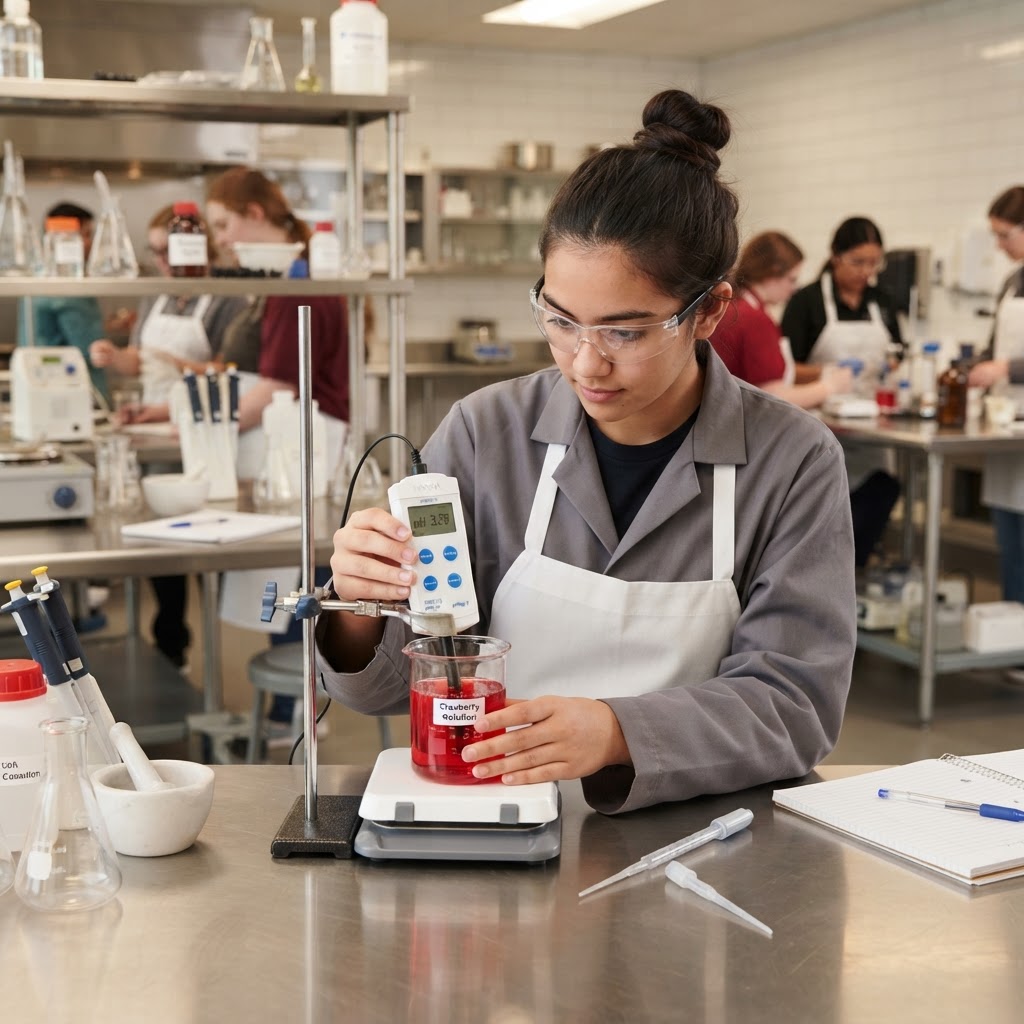
Teaching Students to Measure pH in Culinary Labs
Students often struggle to connect pH readings with actual food performance in the kitchen. This breakdown of acidity concepts helps your class master measurement techniques to improve their culinary outcomes.
The Chemistry of Sour and Sweet
Students often view pH as a mysterious number on a bottle of test strips. In reality, pH is a fundamental measure of the concentration of hydrogen ions in an aqueous solution. When you teach food science, you are teaching the chemistry of how those ions influence everything from the flavor profile of a vinaigrette to the structural integrity of a pectin gel. Understanding the scale allows students to move beyond memorizing rules to predicting how food components will behave.
The pH scale ranges from 0 to 14. A pH of 7 is neutral. Values below 7 indicate an acidic solution, while values above 7 indicate a basic or alkaline solution. Because the scale is logarithmic, each whole number represents a ten-fold change in acidity. This means a liquid with a pH of 4 is ten times more acidic than a liquid with a pH of 5. Helping students grasp this exponential relationship prevents them from assuming that a small change in pH is insignificant in a recipe.
Acids as Culinary Tools
Acids provide the bright, sharp notes that balance heavy or fatty flavors. Beyond taste, acids play a critical role in food preservation and texture modification. In canning, the pH level determines whether a product is safe for boiling water bath processing. Pathogenic bacteria like Clostridium botulinum struggle to grow in environments with a pH below 4.6. This specific threshold is the standard cutoff for safe high-acid food preservation.
Acids also interact with proteins and starches in predictable ways. In meat cookery, a mild acid like lemon juice or yogurt can denature proteins, which alters the texture of the finished dish. In baking, acids react with leavening agents like baking soda to produce carbon dioxide gas. If students understand the reaction between an acid and a base, they can troubleshoot why a cake failed to rise or why a sauce curdled when an acidic ingredient was added.
Measuring pH in the Classroom
Accurate measurement is the foundation of scientific inquiry. In the kitchen, you can use several methods to determine pH. pH paper or test strips provide a quick estimation by changing color based on the acidity of the sample. These are cost-effective and easy for students to use. However, they rely on visual interpretation and are prone to error if the food is highly colored, such as cranberry juice or balsamic vinegar.
Digital pH meters provide greater precision and accuracy. They measure the potential difference between two electrodes and display a numerical value. When you use meters with your students, emphasize proper calibration. A meter is only as good as the buffer solutions used to calibrate it. Teach students that calibration is not an optional step but a necessary procedure for ensuring their data is reliable. Discussing the difference between precision, which is consistency in measurement, and accuracy, which is how close a measurement is to the true value, helps students become better lab observers.
The Variable Nature of Food
Food is complex. Unlike a pure chemical solution, food contains fats, proteins, sugars, and particles that can interfere with sensors. This complexity means that pH readings can fluctuate even within the same batch. Encourage students to take multiple readings from different parts of a sample to calculate an average. This practice teaches them to account for variability and reduces the impact of localized concentration differences.
Common misconceptions arise when students think pH is a static property of an ingredient. It is a property of a mixture. Adding water, salt, or sugar to an acidic ingredient changes the concentration of ions and, therefore, the final pH. Challenge your students to predict how diluting a lemon juice sample with water affects its pH. These small experiments reveal that chemistry happens in every bowl they stir.
Key Takeaways
- The pH scale is a logarithmic measure of hydrogen ion concentration where values below 7 indicate acidity and values above 7 indicate alkalinity.
- Food safety in preservation depends on acidity, specifically maintaining a pH below 4.6 to inhibit the growth of dangerous bacteria.
- Proper calibration of digital meters is essential for obtaining accurate data, as environmental factors and equipment drift can easily skew results.
- Measuring pH in food requires care because complex mixtures of fats and solids can interfere with sensor readings and lead to variability.
Was this article useful?
Sign in with a free or paid account to react. A paid plan is not required.
Enjoy this post? Subscribe to get new Food Science Toolbox articles delivered to your inbox.