
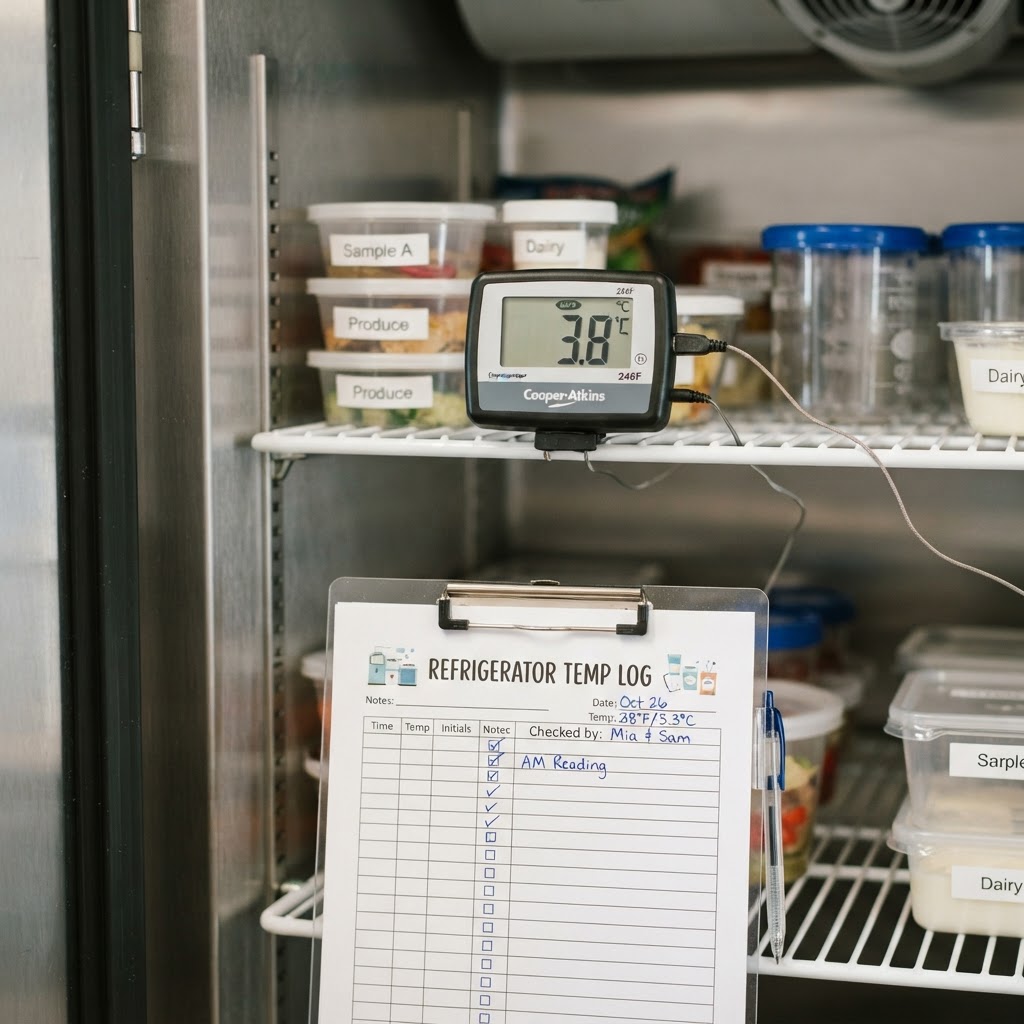
Solve a classroom challenge with Refrigerator & Freezer Monitoring Checklist
Consistent temperature logs are difficult to maintain during busy lab days. Use the Refrigerator & Freezer Monitoring Checklist to standardize your data collection and keep your equipment safe for every inspection.
Managing Temperature in the Classroom Kitchen
Food safety in a school environment requires moving beyond vague instructions like keeping things cold. Pathogenic bacteria, such as Salmonella and Listeria, thrive in the temperature danger zone, which spans from 41 degrees Fahrenheit to 135 degrees Fahrenheit. In a school kitchen, fluctuating temperatures often result from frequent door openings, overstocked shelves, or equipment nearing the end of its lifespan. To maintain safety, you must monitor internal storage conditions with scientific precision.
Temperature monitoring is an exercise in data collection and risk management. Accuracy is the degree to which your thermometer reflects the actual temperature of the air or the food product inside the unit. Precision, on the other hand, refers to the consistency of those readings over time. If your thermometer reads 35 degrees every day but the actual temperature is 40 degrees, your reading is precise but not accurate. A consistent, daily log helps you identify these discrepancies, allowing you to troubleshoot equipment before a significant food safety hazard occurs.
The Physics of Refrigeration
Refrigerators function by removing heat from an insulated space. A refrigerant fluid evaporates, absorbing thermal energy from the interior, and then releases that heat outside the unit. When you open a refrigerator door, cold air escapes and is replaced by warmer room-temperature air. If this occurs dozens of times during a class period, the compressor must work continuously to pull the temperature back down to a safe level. Students often do not realize that the compressor has a recovery time.
Thermal mass plays a significant role in how well a refrigerator maintains its set point. A full refrigerator has more items with high heat capacity, such as liquids and dense foods, which act as a thermal buffer. These items hold onto their cold temperature even when the air temperature spikes temporarily. An empty refrigerator loses cold air almost instantly when the door is opened. Teaching students to keep refrigerators organized and properly stocked is not just about cleanliness, it is a lesson in thermodynamics.
Analyzing Trends in Data
Collecting data is only the first step. The true value lies in interpreting the logs to make informed decisions. When you observe a steady increase in temperature over several days, it often suggests a mechanical issue, such as a failing door gasket or dust-clogged condenser coils. These external factors can significantly impact the efficiency of your equipment. By recording these numbers daily, you create a historical record that justifies maintenance requests or alerts you to potential power outages that occurred overnight.
Consider the difference between correlation and causation when looking at your logs. If the temperature spikes after a class period where students opened the door repeatedly to fetch ingredients, the cause is likely door usage. If the temperature rises when the room is empty and the unit has been closed for hours, the cause is likely a mechanical failure. Helping students distinguish between these two scenarios moves them from passive learners to active observers of food safety systems. This analytical approach mimics real-world Hazard Analysis and Critical Control Point procedures used in professional food production.
Ensuring Safety Through Standardized Practice
Consistency is the hallmark of any high-quality science program. Using a standardized, accessible form for tracking temperatures ensures that data collection remains a priority, even when classes are chaotic. A clear, visual tracking system encourages students to take responsibility for their station. It transforms a routine task into a tangible lesson on the importance of regulatory compliance and equipment care. When students understand why they are recording these numbers, they start to see the refrigerator not as a static box, but as a dynamic environment that requires constant attention to keep food safe.
Maintaining an organized tracking system also simplifies your administrative burden during health inspections. Being able to show a complete, legible record of daily temperatures demonstrates that your program values safety and scientific diligence. It eliminates the guessing game when issues arise and provides a clear audit trail for school administrators or health department officials. This practice effectively bridges the gap between theoretical classroom science and the realities of professional kitchen operations.
A Practical Teaching Tool
The Refrigerator & Freezer Monitoring Checklist provides the structure you need to manage classroom temperatures with precision. This resource simplifies the daily task of tracking, helping you and your students maintain a safe, organized, and inspection-ready food storage space. By integrating this consistent logging method into your daily lab workflow, you reinforce critical safety habits and provide a clear, evidence-based approach to equipment management.

Was this article useful?
Sign in with a free or paid account to react. A paid plan is not required.
Enjoy this post? Subscribe to get new Food Science Toolbox articles delivered to your inbox.