
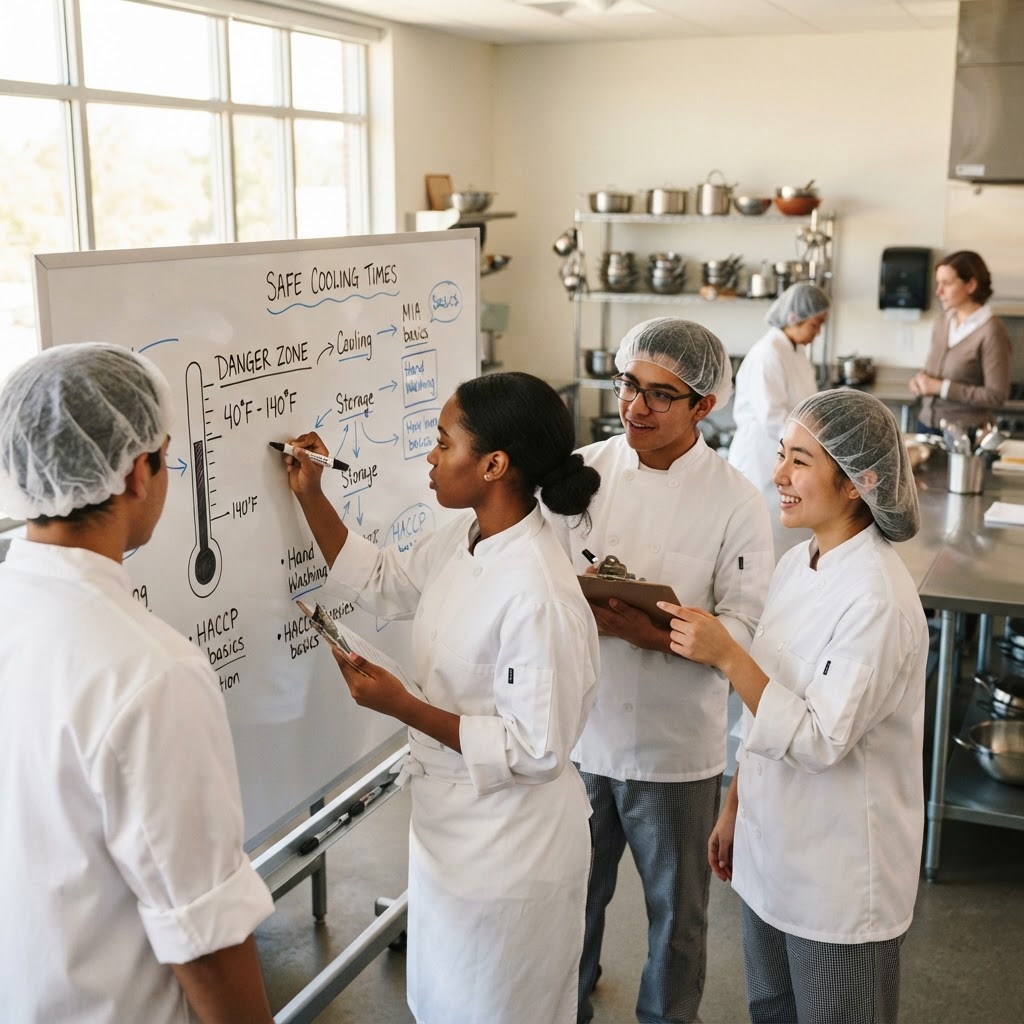
Empowering Students to Draft Their Own Kitchen Safety Protocols
Students often treat kitchen safety rules as optional obstacles. This strategy helps them draft their own evidence-based protocols so they take ownership of food safety through real scientific reasoning and risk management.
When students view kitchen safety as a rigid list of rules, they often see it as something to bypass rather than a foundational skill. Shifting the focus from rule-following to risk assessment transforms their role from passive followers to active managers of their food environment. By drafting their own protocols, students apply scientific principles to everyday culinary tasks, moving beyond rote memorization to a conceptual understanding of food chemistry and microbiology.
Food safety is fundamentally about managing variables. Pathogens like Salmonella, Listeria monocytogenes, or Staphylococcus aureus are invisible and opportunistic. They require specific environmental conditions—moisture, pH, oxygen availability, and temperature—to survive and proliferate. When students write their own procedures, they must consider the Danger Zone, which is the temperature range between 40 degrees Fahrenheit and 140 degrees Fahrenheit (4°C to 60°C) where microbial growth occurs most rapidly, often doubling in population every twenty minutes under ideal conditions. A student who understands this thermal limit can justify why they need to store cold ingredients promptly rather than leaving them on a warm counter, recognizing that temperature abuse effectively removes the safety barrier between a raw ingredient and a foodborne illness.
Understanding Microbial Control
The primary goal of a safety protocol is the reduction of the microbial load. You can help students distinguish between cleaning and sanitizing by grounding these concepts in cellular biology and chemistry. Cleaning involves the physical removal of visible soil, lipids, and organic matter through the use of surfactants found in soaps and detergents. These surfactants work by lowering surface tension, allowing water to lift grease and debris off surfaces. Sanitizing, however, involves the reduction of pathogens to a level that is considered safe for public health, typically through thermal energy or chemical agents that disrupt microbial cell membranes or denature their essential proteins.
Ask students to analyze a common kitchen station. If they leave a wooden cutting board dirty after prepping raw chicken, they are providing a porous substrate where bacteria can hide in microscopic fissures, potentially forming biofilms—complex communities of bacteria protected by a self-produced matrix of extracellular polymeric substances. Their protocol should reflect this reality. They might argue for the use of non-porous surfaces like high-density polyethylene for poultry, or mandate a specific concentration of a chlorine-based sanitizer solution to effectively penetrate the surface. This shifts their thinking from simply wiping a counter to active risk mitigation, requiring them to account for contact time and chemical concentration.
Applying Quantitative Reasoning
Scientific protocols require precision. When students design their own procedures, they must define the parameters for success. For example, a student might draft a rule regarding handwashing. A general rule says to wash for twenty seconds. A scientific protocol specifies the water temperature—ideally around 100°F (38°C) to optimize soap lathering—the type of soap, and the mechanical friction required to dislodge microbes from the epidermal crevices. This introduces the idea of standardization, where identical processes lead to predictable and consistent safety outcomes, mirroring the control variables in a chemistry experiment.
Encourage students to use tools to measure these variables. If they draft a rule about dishwashing, they should investigate the required temperature for a heat-based dishwasher cycle, which often requires a surface temperature of at least 160°F to ensure effective pathogen destruction. This brings thermodynamics into the kitchen as they consider heat transfer rates and the thermal denaturation of microbial proteins. When the process is defined by quantitative data, the rules stop feeling arbitrary. They become a logical extension of the scientific method, where the goal is to create a reproducible, verified safe environment.
Managing Cross-Contamination
The movement of pathogens from one surface to another via vectors—such as human hands, utensils, or cutting boards—is a critical focus for any safety protocol. Students often struggle to visualize how a single drop of liquid or a stray crumb can transfer millions of organisms. Use the example of cross-contamination to discuss the vectors of transport in your lab. A student who creates a protocol must identify the specific points where their hands, tools, or ingredients might pick up and relocate contaminants, such as transferring raw meat juices to ready-to-eat produce.
Challenge your students to create a workflow for a multi-step recipe. If they are prepping vegetables after working with meat, what is their specific transition process? They should outline a sequence that isolates clean tasks from dirty tasks, perhaps utilizing color-coded equipment to physically prevent the mixing of hazard-prone materials. By documenting these steps, they practice the same rigorous thinking used in professional food production facilities where Hazard Analysis and Critical Control Points, or HACCP, is the standard for safety. This framework forces them to identify Critical Control Points—the specific stages where a hazard can be prevented, eliminated, or reduced to an acceptable level.
Key Takeaways
- Kitchen safety protocols are most effective when students understand the biological mechanisms behind temperature control and microbial growth.
- Distinguishing between cleaning and sanitizing helps students choose the correct methods to reduce pathogen populations on various surfaces.
- Defining procedures through quantitative measurements, such as temperature and time, transforms arbitrary rules into evidence-based systems.
- Developing custom workflows forces students to identify and mitigate the risks of cross-contamination throughout the cooking process.
Was this article useful?
Sign in with a free or paid account to react. A paid plan is not required.
Enjoy this post? Subscribe to get new Food Science Toolbox articles delivered to your inbox.